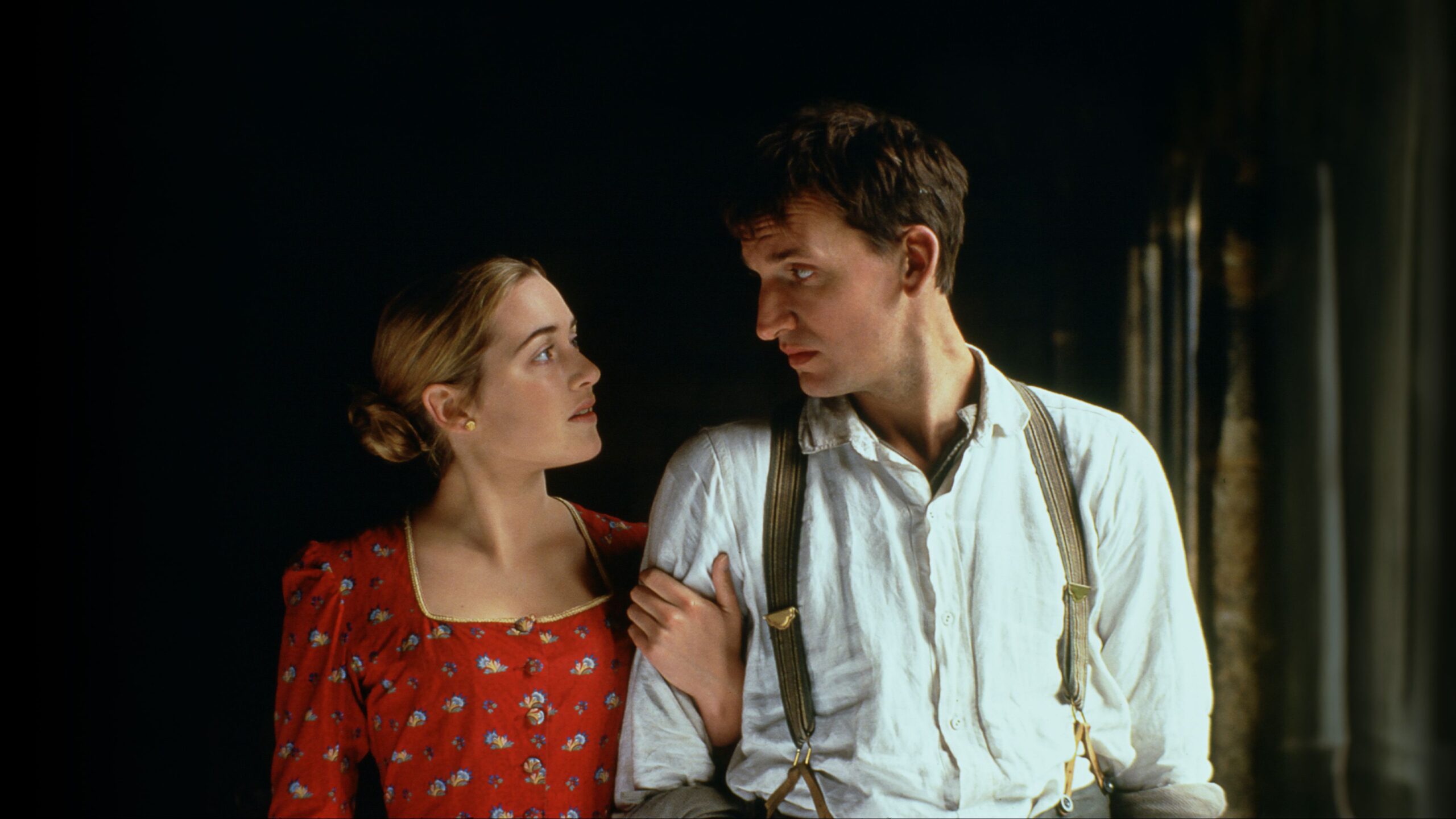
There are thousands of films that include nude scenes, sex scenes, and erotic cinema moments, but only a few actually stay with us. Most are designed to look aesthetic, controlled, or emotionally safe. A smaller group breaks that distance completely. Michael Winterbottom’s Jude (1996), starring Christopher Eccleston and Kate Winslet, belongs to that category.
What makes the intimate scene between Jude and Sue so striking is how it treats intimacy as emotional collapse rather than cinematic performance. It is not about stylized nudity or soft erotic suggestion. It is about two characters crossing a boundary that has been building from the beginning of the film.
Sue’s intellectual independence and emotional resistance, shaped by a deep skepticism of religious convention rather than religious belief itself, create constant tension between her and Jude. That tension never feels decorative. It feels like pressure, always present underneath their connection, shaping every moment of physical closeness and emotional distance.
When the scene finally happens, it does not feel like a typical movie sex scene. It feels like release after restraint. The breaking point emerges from the accumulated weight of their impossible situation, socially condemned as cousins and emotionally entangled beyond retreat, and what follows is a shift from emotional control into surrender. The intimacy is not framed as fantasy or spectacle, but as something immediate and unavoidable.
Kate Winslet’s performance is central here. It was also her first time filming a nude scene, and the discomfort was real. She later recalled: “I had to remember why I was doing it. We’d have to reshoot because I had my arm across Chris’s face. It took all day and I was very, very nervous. But I thought my body looked great.” That tension between anxiety and hard-won confidence is exactly what the scene itself is about. Sue Bridehead is not written as simply open or closed off. She exists in contradiction, carrying desire and resistance at the same time. Christopher Eccleston’s Jude mirrors that intensity with restraint, never turning the moment into performance or exaggeration.
The direction reinforces this rawness. Winterbottom avoids stylizing the bodies or turning nudity into aesthetic distance. The camera stays close, emphasizing proximity, breath, and emotional exposure rather than framing it as a polished erotic moment.
This is also what makes the scene stand out in discussions of erotic cinema and sex scenes in movies: it refuses to sanitize physical intimacy. It includes nudity in a way that feels unprotected, where the presence of bodies is not softened or abstracted.
Even details like visible skin, touch, and physical closeness are not treated as spectacle, but as part of the emotional realism of the moment. The film does not isolate the body from the relationship. It embeds it inside the emotional collapse happening between the characters.
What makes the scene memorable is not “what happens,” but what becomes impossible afterward. Jude and Sue are no longer operating in emotional theory. The distance between belief, fear, and desire has collapsed into physical reality.
Ultimately, the bed scene in Jude works because it treats sex and nudity not as spectacle, but as truth breaking through restraint. It is one of the rare erotic film scenes where intimacy is not performed for the camera. It simply happens, and the film refuses to look away.