There is a conversation the film industry has never quite been willing to have honestly. It acknowledges that sex scenes are serious dramatic craft requiring skill, vulnerability, and professional courage. It insists simultaneously that these scenes bear no meaningful resemblance to softcore porn production. Both positions are maintained with considerable institutional investment in keeping them from colliding.
But the more you look at what actually happens on these sets, and the more you listen to what actresses say when they drop the diplomatic framing, the clearer it becomes that the resemblance to softcore porn is real, the physical experience is real, and the industry’s categorical insistence on denying both is itself the problem. The honest position is not that these scenes are pornography. It is that they share enough with softcore porn production to deserve frank acknowledgment rather than anxious denial, and that the actresses who approach them with clear eyes and zero apology are the ones doing it right. More than that: they are the ones telling the truth about human sexuality in a culture that persistently refuses to.
The Setup Is What It Is
Strip away the context and describe the physical reality plainly.
A woman removes her clothes on a lit set. She is placed in physical contact with another person in positions that simulate sexual activity. A director gives her notes on how to move, how to position her body, how to hold her expression. A camera operator films her from angles chosen specifically to capture the intimacy and exposure of the moment. Multiple crew members watch this happen live, repeatedly, across multiple takes.
In certain productions, what occurs between the actors goes well beyond clean simulation. Bodies are pressed together with real physical contact. A co-star’s mouth makes contact with a woman’s breasts. Sustained physical positioning that in any other context would constitute sexual activity is held, adjusted by the director, and held again across dozens of takes. The physical sensation is real even when the act is not consummated. Extended nude contact between two people, directed and filmed over hours or days, produces physical and psychological effects that the word “simulated” does not cleanly cover.
Now describe a softcore porn shoot. A woman removes her clothes on a lit set. She is placed in physical contact with another person in positions that simulate or perform sexual activity. A director gives her notes on how to move, how to position her body, how to hold her expression. A camera operator films from angles chosen to capture exposure and intimacy. Multiple crew members watch, across multiple takes.
The physical mechanics are, sentence for sentence, nearly identical. The difference lives not in what the body is doing but in what surrounds that body: the narrative context, the dramatic intent, the commercial apparatus the footage feeds into, and the meaning the performers and filmmakers are attempting to create. These differences are real and they matter enormously. But they are differences of frame, not of physical fact.
The actress standing on that dramatic film set is not in a softcore porn shoot. She is also not in a situation that bears no resemblance to one. Both things are simultaneously true, and the industry’s compulsive insistence on only the first half of that sentence is what makes honest conversation about these scenes nearly impossible.
Kate Winslet in Jude: The Most Physically Explicit Starting Point
Before Winslet became one of cinema’s most decorated performers, before Titanic and The Reader and Mare of Easttown, she was a 20-year-old actress on the set of Michael Winterbottom’s 1996 adaptation of Jude the Obscure, delivering what remains one of the most openly softcore-adjacent scenes in mainstream British cinema.

The sequence is not ambiguous about what it shows. Winslet removes her dress and becomes completely naked. She lies on the bed where her breasts and pubic hair are clearly visible. Her co-star then places his mouth on each of her breasts as they begin to make love.
That description, read plainly, describes an act of real physical contact of a sexual nature. Not simulated breast contact. Not implied breast contact. A man’s mouth on a woman’s nipples, on camera, held long enough to register in the scene. In softcore porn, this is a standard sequence. In a prestige literary adaptation, it is called “dramatic realism.” The camera does not know the difference. The actress’s body does not know the difference. The mouth performing the act does not know the difference.
Winslet appeared full frontal nude in this film. When asked how comfortable she was with her first nude scene, she said: “Not at all. No way. Oh, it was awful. I was so nervous, I starved myself for a month. I went through all the paranoias: My bum’s massive. My breasts are saggy. I’ve got a spotty back, chicken arms. I can’t do it.”
She did it anyway. And her reasoning for doing it is exactly what makes the scene worth examining: she described it as a turning point she had to honor. She did not describe the physical content of the scene as categorically different from anything else. She described it as terrifying and then chose to proceed. That is not the behavior of someone who believes the scene bears no resemblance to softcore porn production. That is the behavior of someone who understands precisely what she is walking into, is frightened by it, and walks in anyway because the dramatic work demands it.
Years later, with the accumulated weight of an entire career’s worth of intimate scenes behind her, Winslet’s retrospective verdict on what those early productions required is the most honest accounting available from any major actress. She said: “I would have benefited from an intimacy coordinator every single time I had to do a love scene or be partially naked or even a kissing scene.” She described the thoughts she could not voice: “I don’t like that camera angle. I don’t want to stand here full-frontal nude. I don’t want this many people in the room. I want my dressing gown to be closer.”
Parse what that means for the Jude scene specifically. She was fully naked. A man was sucking her nipples. A crew of people was watching and filming this. She had thoughts she could not voice about the camera angles, about the number of people in the room, about not wanting her robe further away. The physical and psychological experience she was having is the physical and psychological experience of performing in a softcore porn production. The difference between her situation and that of a softcore performer in an equivalent scene is not the physical content of what was happening to her body. It is the dramatic context in which it was happening and the artistic purpose it served.
Both things are real. Both things matter. The physical reality does not cancel the artistic legitimacy. The artistic legitimacy does not cancel the physical reality.
Margot Robbie: Owning the Softcore Charge Completely
Margot Robbie on the set of The Wolf of Wall Street in 2013 represents the clearest example of an actress who looked at the softcore-adjacent nature of her scene, understood it fully, and made it the entire point.
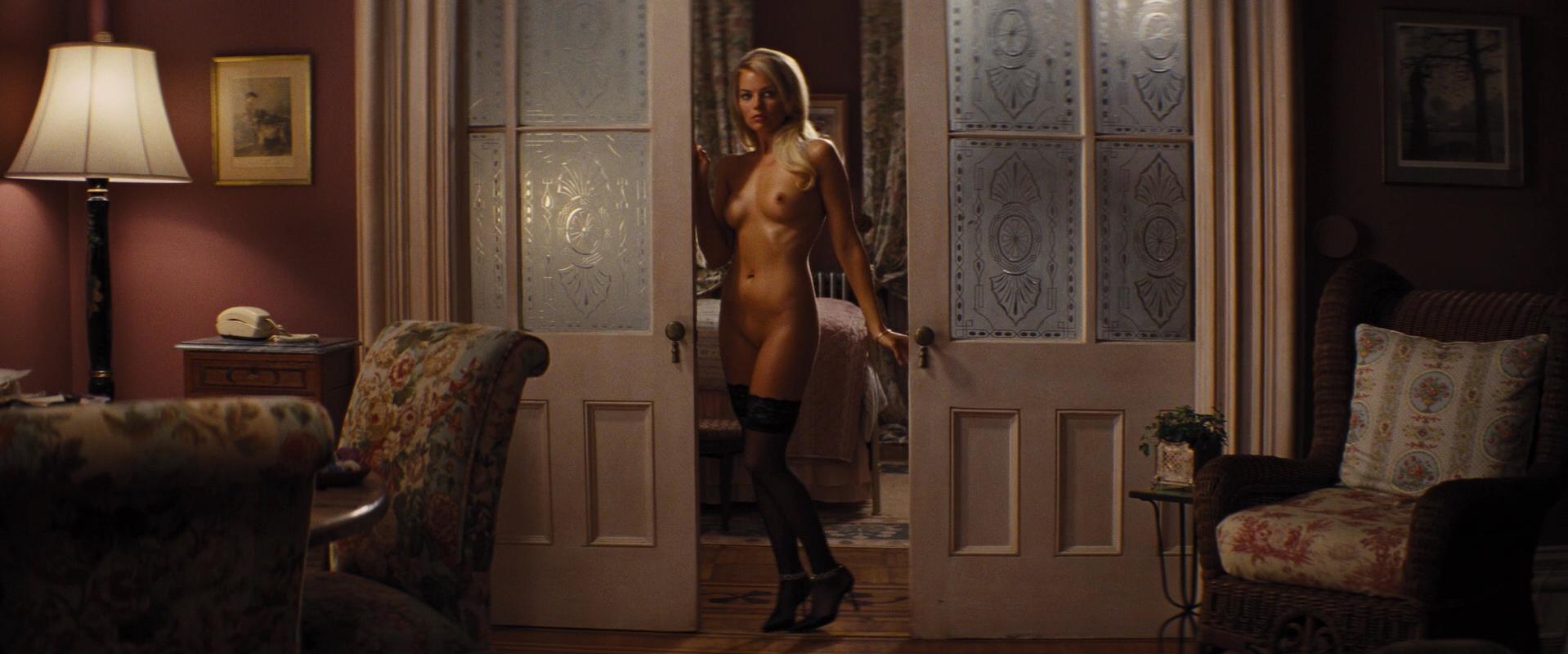
The scene she filmed is, by any honest description, softcore porn embedded in a Scorsese film. A young woman, entirely naked, full frontal, using her body as a weapon of seduction, filmed in explicit detail for maximum sexual charge. The dramatic purpose is inseparable from the pornographic charge: Naomi’s power in that scene comes precisely from the fact that what she is doing reads as softcore display. Strip out the porn charge and there is no scene. The drama lives inside the softcore content, not around it.
Martin Scorsese offered Robbie a robe. She refused, saying: “That’s not what she would do in that scene. The whole point is that she’s going to come out completely naked — that’s the card she’s playing right now.”
That reasoning is a direct acknowledgment that the softcore content was the dramatic mechanism. The card Naomi is playing is her naked body deployed as sexual power. It works as drama because it works as softcore display. Robbie understood this, named it in the language of character logic, and executed it with complete ownership.
She took a couple of shots of tequila beforehand out of nerves, and afterward her bigger concern was not her performance but the fact that everyone was going to see this, including her family. The nerves were real. The discomfort was real. The awareness of what she was producing and for whom was real. And she did it with full professional clarity about all of it.
This is not victimhood. This is not exploitation. This is an actress who knew she was producing softcore content with a dramatic frame around it, decided that was the right choice for the character, and delivered it without apology. That is a more sophisticated and honest relationship to the material than the industry’s standard position allows.
Blue Is the Warmest Color: When Softcore Becomes the Method
If Robbie’s example demonstrates clarity and ownership, Blue Is the Warmest Color demonstrates what happens when a director decides that the proximity of dramatic filmmaking to softcore porn is not a tension to manage but a condition to maximize, with two actresses as the material.
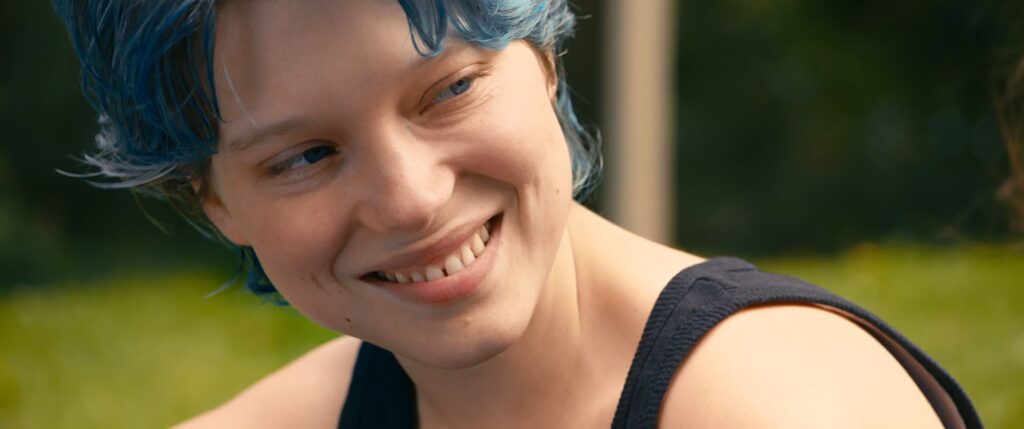
The film contains a central sex scene between Léa Seydoux and Adèle Exarchopoulos that runs approximately seven minutes on screen. Seven minutes of two women engaged in explicit, graphically filmed sexual activity. The scene is explicit enough that the film received an NC-17 rating in the United States and generated immediate debate about whether it constituted softcore lesbian pornography dressed in art house framing. That debate was not frivolous.
The seven-minute sequence required over 100 takes for a single shot and took 10 days to film. Ten consecutive days. Both actresses fully or partially nude. Performing explicit sexual activity, repeatedly, across hundreds of takes, under a director who wanted to shoot the scenes without choreography because choreography, as Exarchopoulos put it, “desexualizes the act.”
Kechiche wanted the act to remain sexualized. He wanted the camera to capture something that retained the charge of real sexuality rather than the managed, defused quality of professionally staged intimate scenes. In other words, he wanted to close the distance between dramatic filmmaking and softcore porn production as much as he possibly could, because that closing of distance was his artistic method.
The overall production went three months over schedule, with cast and crew eventually working seven days a week. The sex scenes were not an anomaly. They were the logical endpoint of a directorial philosophy that treated physical and emotional exhaustion as a resource to mine.
Seydoux’s account of her experience is the most striking statement any major actress has publicly made about what filming intimate scenes actually produces in the body and mind. She told The Independent: “Of course it was kind of humiliating sometimes, I was feeling like a prostitute. He was using three cameras, and when you have to fake your orgasm for six hours… I can’t say that it was nothing.”
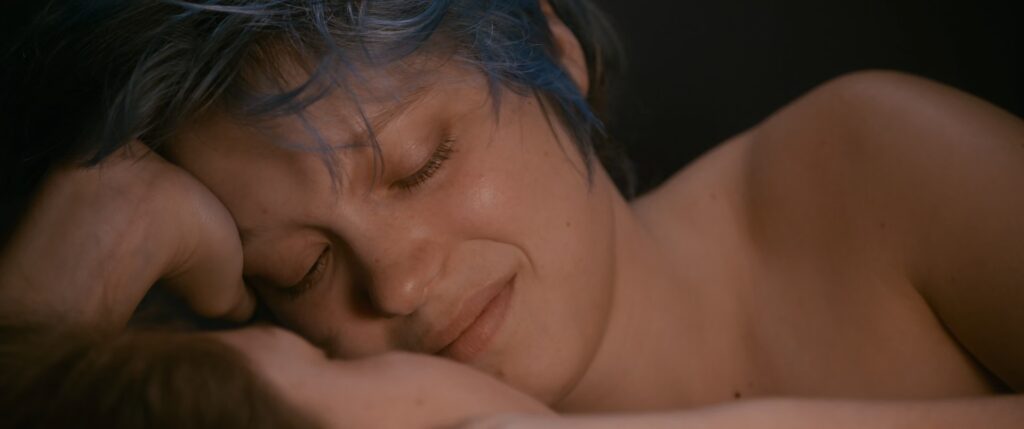
Faking orgasm for six hours. Across multiple cameras. Across ten days of shooting. That is not acting in the conventional sense of the word. That is a physical performance of sexual response, sustained across an industrial duration, in conditions that Seydoux herself said made her feel like a prostitute. Not a porn performer. A prostitute. Someone whose body is being used for another person’s purposes under conditions of coercive power imbalance, without adequate protection or consent architecture.
Both actresses explicitly denied that actual sex occurred between them. What happened was not consummated. What happened was ten days of nude physical contact, simulated sexual activity across hundreds of takes, without choreography, without the desexualizing framework that professional intimacy management provides, directed by a man deliberately pursuing the erasure of the line between dramatic performance and softcore porn. The artistic result was a Palme d’Or. The physical and psychological experience of producing it, by Seydoux’s own account, crossed into territory she experienced as sexual exploitation.
That both of these things are true about the same film is the most extreme version of the tension this entire article is examining.
Emilia Clarke: The Full Arc of a Career in This Territory
Emilia Clarke’s Game of Thrones experience charts the complete trajectory that working in softcore-adjacent dramatic territory produces across years, and it is more illuminating than any theoretical argument.

In the early seasons, Clarke agreed to substantial nudity partly because she lacked experience to fully process what she was agreeing to: “I have no idea what I’m doing. I’m now on a film set completely naked with all of these people, and I don’t know what I’m meant to do, and I don’t know what’s expected of me.”
That is the account of someone in the same psychological territory as a first-time softcore performer: physically exposed, surrounded by professionals treating her nudity as routine, uncertain of the norms, uncertain of her own limits. The prestige of the production does not alter the physical and psychological reality of that experience. The content being produced is different. The lived experience of the body in that moment shares substantial overlap regardless.
She developed a clear framework as she gained standing. She articulated it directly: “In drama, if a nude scene forwards a story or is shot in a way that adds insight into characters, I’m perfectly fine with it. If it’s gratuitous for gratuitous sake, then I will discuss with a director on how to make it more subtle.”
This is the framework of someone who has accepted that she works in territory adjacent to softcore porn and has developed criteria for when that territory serves the work and when it is gratuitous sexual display with a dramatic label on it. She is not pretending the territory does not exist. She is navigating it on her own terms.
Her response to cultural judgment was equally direct. When women criticized her for nude and sex scenes, she called that response “antifeminist,” adding: “Women hating on other women is just the problem.” What she was defending was her right to work in softcore-adjacent dramatic territory without being treated as though she had collapsed the distinction entirely. The distinction is real. But she defended the work rather than denied the territory.
By later projects, when producers invoked her Game of Thrones nudity to pressure her into more explicit content, telling her she did not want to disappoint fans, she told them directly: “Fuck you.” That is not the response of someone who thinks dramatic nudity and softcore porn are unrelated. It is the response of someone who recognizes the commercial logic driving the request, sees it as the same commercial logic that drives softcore content production, and refuses to be managed by it.
What the Body Doesn’t Know
The body is not a sophisticated interpreter of framing and intent.
When skin contacts skin in extended sequences, when a man’s mouth makes contact with a woman’s breasts, when bodies are positioned in configurations that produce real physical sensation regardless of dramatic purpose, when orgasm is performed repeatedly across a production schedule to the point of burnout, the nervous system responds to physical reality. It does not consult the script or factor in whether what is being produced is a Palme d’Or contender or a softcore production for streaming.
Seydoux faking orgasm for six hours across three cameras is having a physical experience. Kidman reaching orgasm burnout on the set of Babygirl is having a physical experience. Winslet lying fully naked while a man’s mouth moves across her breasts on the set of Jude is having a physical experience. These are real physical events happening to real bodies, and the word “acting” does not fully account for them.
The actresses who handle this territory best are not the ones who deny the physical reality or insist it is categorically unrelated to what happens in softcore porn production. They are the ones who acknowledge the reality, accept it as part of the work they do, and make deliberate and fully conscious professional decisions about when and how to operate within it.
The Spectrum, Plainly Stated
Not all sex scenes are the same, and the industry’s insistence on treating them as a single category distorts every conversation.
Clothed actors kiss and the camera cuts: zero resemblance to softcore porn.
Brief, contextual nudity in a non-sexual moment: minimal overlap.
Simulated sex under sheets, implication without explicit display: the overlap with softcore porn is present but limited. The physical reality is managed.
Full frontal nudity in an extended seduction sequence, filmed for explicit sexual charge, as Robbie did: substantial overlap with softcore porn in what the footage produces and what it required from the performer. The dramatic purpose is real. So is the softcore content.
A man’s mouth on an actress’s breasts, filmed without modesty garments, as happened in Jude: this is softcore content. It is also a scene in a serious literary adaptation. These two things coexist without canceling each other.
Faking orgasm for six hours across multiple cameras over ten days of shooting, resulting in the performer describing herself as feeling like a prostitute: this is as close as mainstream dramatic filmmaking has publicly come to crossing the line entirely. The artistic result distinguished the line. The physical experience of crossing it was described in terms that leave no room for the industry’s comfortable categorical denial.
Shamelessness as the Correct Professional Position
Robbie’s approach is the model. She looked at a scene that would produce softcore content, understood that this was the scene’s dramatic mechanism, and executed it with complete professional ownership. She did not need the protective framing of insisting it was not softcore-adjacent.
Clarke’s later clarity is the same understanding reached through a harder path. Kidman’s account of Babygirl is the same understanding pushed to the physical limit and reported with extraordinary candor. Winslet’s retrospective wish for protection is the honest accounting of someone who did the work without the framework that would have allowed her to do it on fully conscious terms.
All of these actresses are telling the same story in different registers. The story is: this work is real, it happens in the body, it shares physical and psychological territory with softcore porn production, the dramatic frame matters enormously and does not neutralize the physical reality, and the women who do it with full ownership and zero apology are the most honest people in the room.
Sexuality Is Not the Problem
Underneath all of this is a deep cultural discomfort with human sexuality that the film industry simultaneously exploits and anxiously disavows. The machine extracts commercial and artistic value from softcore-adjacent dramatic content and then insists the content is not what it functionally is, because naming it honestly would require confronting the fact that sexuality on screen is real, potent, and does things to both the people producing it and the people watching it.
Human sexuality is not a problem requiring management. It is one of the most fundamental forces in human experience. It is the engine of intimacy, desire, power, and connection. It is how human beings know each other most fully and most vulnerably. It is inseparable from the deepest questions of identity, agency, and what it means to inhabit a body in relation to other bodies.
Art that engages sexuality honestly, that sits on the border between drama and softcore porn and refuses to pretend otherwise, that asks actresses to experience real physical things in the service of telling true stories about desire and power, is doing something that matters. It is doing something that only cinema can do, and it is doing it because human sexuality deserves to be looked at directly rather than managed into aesthetic safety.
Winslet lying naked while a man’s mouth moves across her breasts. Robbie walking out with nothing left to hide. Seydoux faking orgasm for six hours until she felt stripped of something. Kidman reaching the physical limit of what a body can sustain in the service of depicting desire. Clarke telling industry executives to go to hell when they tried to exploit the territory she had already navigated on her own terms.
These are not cautionary tales. They are accounts of human beings engaging with human sexuality in the most public medium that exists, with the courage to do it honestly, and the intelligence to understand what they are doing while they are doing it. The industry would be better served by saying so plainly.
Sexuality is human. It is real. It is not diminished by being filmed. And the women who put their bodies inside that truth, with full awareness of where they are standing, deserve a more honest conversation than the one the industry has been willing to have.